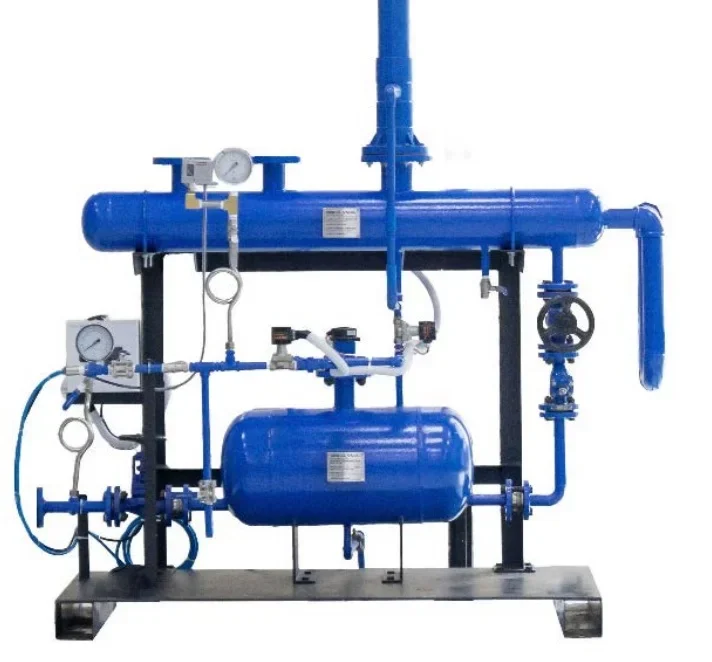
The VMAL Pressure Operated Pump is an automatic condensate transfer pump designed to recover and transfer high-temperature condensate and other suitable process liquids without relying on a conventional electric centrifugal pump. The VCOP series uses steam, compressed air, or another suitable gas as the motive force to discharge condensate against higher elevations or system back pressure.
Unlike conventional electric pumps, the VMAL pressure operated pump does not use an electric motor to directly pump the condensate. Instead, condensate first enters the pump vessel by gravity. When the liquid reaches the high-level set point, motive steam or compressed air enters the vessel and creates pressure that forces the condensate into the return system.
This operating principle makes the VMAL VCOP suitable for condensate recovery systems, steam systems, boiler feedwater return, heat exchangers, reactors, and industrial process applications where hot condensate needs to be transferred reliably.
Need help selecting the right VMAL pump size? Contact Valvelink with your motive pressure, back pressure, condensate load, and operating conditions for a suitable configuration.
VMAL Pressure Operated Pump for Condensate Recovery
The VMAL VCOP is designed primarily for the recovery and transfer of high-temperature condensate. After steam releases its latent heat in a heat exchanger or other process equipment, it condenses into liquid. This condensate can still contain considerable thermal energy and can be returned to the boiler feedwater system instead of being discharged as waste.
The VMAL condensate transfer pump uses steam or compressed air as the motive medium. The pressure generated by the motive medium pushes the collected condensate out of the pump vessel and into the condensate return line.
This approach is particularly useful when conventional electric pumps may experience operating difficulties because of hot condensate and flash steam. The VMAL pump is designed to transfer condensate under these conditions without depending on an electric centrifugal pumping mechanism.
What does “pressure operated pump” mean?
A pressure operated pump uses pressure from an external motive fluid to move the liquid being pumped.
In the case of the VMAL VCOP:
- Hot condensate enters the receiver by gravity.
- The condensate gradually fills the pump vessel.
- A level controller detects when the condensate reaches the high-level set point.
- The control valve opens.
- Steam or compressed air enters the pump vessel.
- The motive pressure forces the condensate out of the vessel.
- When the liquid reaches the low-level set point, the control valve closes.
- The vessel starts filling again and the automatic pumping cycle repeats.
In simple terms, the VMAL works by collecting condensate, pressurizing the vessel, and pushing the condensate to the return system.
How the VMAL VCOP Pressure Operated Pump Works
The operating cycle of the VMAL condensate transfer pump is automatic.
1. Condensate enters the system
Condensate discharged from steam traps enters the condensate recovery system through the inlet receiver. The condensate flows through the pipeline and check valve before entering the pump vessel.
Because the condensate enters by gravity, the system can collect condensate before the pressure-operated pumping cycle begins.
2. The pump vessel fills
As condensate continues to enter, the liquid level inside the vessel rises.
When the condensate reaches the predetermined high-level point, the level controller detects the condition and sends a signal to the control valve.
3. Motive steam or compressed air enters
The control valve opens and allows motive steam or compressed air to enter the pump vessel.
The motive medium creates pressure inside the vessel. This pressure acts on the collected condensate and forces it toward the condensate return line.
4. Condensate is transferred
The pressure inside the vessel pushes the condensate through the discharge piping toward the boiler feedwater tank or another designated condensate return point.
The VMAL system is therefore capable of transferring condensate to a higher elevation or against higher system pressure, provided that the available motive pressure and pump capacity are suitable for the application.
5. The cycle repeats automatically
Once the condensate level falls to the low-level set point, the level controller closes the control valve and stops the supply of motive steam or compressed air.
The vessel then begins filling again, repeating the automatic pumping cycle. Pump operating frequency depends on the amount of condensate entering the pumping station.
Key Features of the VMAL Pressure Operated Pump
The VMAL VCOP series is designed for industrial condensate recovery and process applications requiring reliable transfer of hot liquids.
Steam or compressed air operated
The pump can use steam, compressed air, or other suitable gases as the motive force. This eliminates the need for an electric motor to directly drive the condensate pumping mechanism.
Designed for high-temperature condensate
The VMAL is designed to transfer high-temperature liquids, including condensate, thermal oils, and other suitable process fluids. The manual specifies a maximum operating temperature of 185°C for the stated pump operating condition.
Suitable for condensate recovery
The pump is designed to recover condensate and return it to the boiler feedwater system, helping the plant reuse the thermal energy contained in hot condensate.
No conventional centrifugal pump mechanism
The VMAL operates using motive pressure rather than a conventional electric centrifugal pumping mechanism. This makes it suitable for applications where hot condensate and flash steam can create cavitation concerns for conventional electric pumps.
High motive pressure capability
The stated limiting conditions specify a maximum motive pressure of 10 bar and a minimum motive pressure of 0.5 bar. Actual pump selection must consider the available motive pressure, back pressure, condensate load, and other operating conditions.
Multiple pump configurations
The VCOP range can be configured as single-, double-, or triple-pump stations to accommodate different condensate loads.
Available system configurations include:
- VCOP-K – Simplex condensate transfer pump system
- VCOP-KD – Duplex condensate transfer pump system
- VCOP-KT – Triplex condensate transfer pump system
Integrated condensate flow monitoring
The pumping station can measure and display the total volume of condensate transferred through an integrated flow counter. This allows operators to monitor recovered condensate and evaluate associated energy savings without requiring an additional flow meter for this monitoring function.
An optional Modbus RS485 communication interface is also specified for remote monitoring of total condensate flow.
VMAL Pressure Operated Pump Specifications
The VMAL VCOP series is available in several nominal sizes and configurations for industrial condensate transfer applications.
| Specification | VMAL VCOP |
|---|---|
| Product type | Automatic condensate transfer pump |
| Pumping principle | Pressure operated |
| Motive medium | Steam, compressed air or other suitable gases |
| Pump material | Carbon steel |
| Stainless steel option | Available as VCOPS |
| Nominal sizes | DN25, DN40, DN50, DN80, DN100 |
| Connection | Flanged EN1092-1 PN16 |
| Alternative connection | ASME B16.5 Class 150 |
| Installation | Horizontal |
| Maximum motive pressure | 10 bar |
| Minimum motive pressure | 0.5 bar |
| Maximum operating temperature | 185°C |
| Capacity | Up to 16,000 kg/h |
| Optional communication | Modbus RS485 |
| System configuration | Simplex, Duplex, Triplex |
The specifications above are based on the supplied VMAL VCOP product manual.
Pump discharge per cycle
The manual specifies the following discharge volume per pumping cycle:
- DN25 to DN50: 16 L/cycle
- DN80: 25 L/cycle
- DN100: 325 L/cycle
The actual flow capacity depends on the pump size, motive pressure, total back pressure, and installation conditions.
VMAL VCOP Models and Configurations
The VMAL range includes several product versions depending on material and system arrangement.
VCOP – Carbon Steel Condensate Transfer Pump
VCOP is the standard carbon steel version of the VMAL condensate transfer pump.
It is available in:
DN25, DN40, DN50, DN80 and DN100.
VCOPS – Stainless Steel Condensate Transfer Pump
VCOPS is the stainless steel version for applications requiring stainless steel construction.
The manual identifies VCOPS as the stainless steel condensate transfer pump option.
VCOP-K – Simplex System
The VCOP-K is a simplex condensate transfer pump system using a single pump.
This configuration can be considered when the application requires a single pumping unit for the expected condensate load.
VCOP-KD – Duplex System
The VCOP-KD is a duplex condensate transfer pump system.
A duplex configuration provides two pumps within the pumping station arrangement and can be selected for applications requiring a different pumping arrangement from a single-pump system.
VCOP-KT – Triplex System
The VCOP-KT is a triplex condensate transfer pump system.
It is intended for systems where a three-pump configuration is appropriate for the condensate load and operating requirements.
Where Is the VMAL Pressure Operated Pump Used?
The VMAL pressure operated pump is intended for industrial steam and process systems where condensate or other suitable hot liquids need to be collected and transferred.
Typical applications supported by the manual include:
Steam condensate recovery
The primary application is recovering condensate from steam systems and transferring it back to the boiler feedwater system.
Instead of allowing valuable hot condensate to be lost, the VMAL system collects and transfers it to the return system.
Heat exchangers
Steam is frequently used as a heating medium in heat exchangers. Once the steam condenses, the resulting hot condensate needs to be removed and returned to the condensate system.
The VMAL can be installed as part of this condensate recovery arrangement.
Process heating equipment
The manual references process heating equipment, reactors, and other industrial process applications where steam is used for indirect heat transfer.
Boiler feedwater systems
The VMAL can transfer recovered condensate back toward the boiler feedwater system, allowing the hot condensate to be reused as part of the steam generation process.
High-back-pressure condensate return
The VMAL is designed to provide condensate transfer under higher back-pressure conditions, provided that the selected pump has sufficient capacity for the actual operating conditions.
Why Use a VMAL Pressure Operated Pump for Condensate?
Hot condensate can be difficult to handle with conventional electric centrifugal pumps. As condensate pressure changes, part of the liquid can flash into steam, creating operating conditions that may lead to cavitation in conventional pumping equipment.
The VMAL pressure operated pump uses motive steam or compressed air to pressurize the pump vessel, rather than using an electric motor and centrifugal impeller to directly pump the hot condensate.
The manual specifically highlights the ability of the VMAL mechanical condensate pump to operate under conditions where flash steam can be present and to avoid the cavitation issues associated with conventional electric pumps.
For condensate recovery systems, this operating principle can provide a practical method of transferring hot condensate toward the return system.
VMAL Condensate Pump Capacity
The VCOP capacity depends on several operating parameters rather than pump size alone.
The supplied capacity chart is based on an installation with a 300 mm filling head above the pump cover, with a 600 mm filling head for the DN100 × DN100 configuration.
The chart provides capacity according to:
- Motive pressure
- Total lift/back pressure
- Pump size
- Installation conditions
For example, the capacity table shows that a DN80 × DN80 VCOP can provide different flow rates depending on motive pressure and total lift.
Therefore, selecting the VMAL pump should not be based on DN size alone.
The available motive pressure and total back pressure are critical for correct pump sizing.
How to Select the Right VMAL Pressure Operated Pump
Correct sizing requires operating data from the condensate system.
The VMAL manual identifies four key pieces of information required for condensate pump selection.
1. Motive steam pressure
Provide the steam pressure available to drive the condensate pump.
For systems using compressed air or another motive gas, the available motive pressure should also be clearly identified.
2. Back pressure
Back pressure is the total pressure that the pump must overcome on the discharge side.
It can include:
- Vertical lift
- Piping distance
- Elbows and fittings
- Isolation valves
- Control valves
- Additional condensate return connections
- Other system pressure losses
3. Maximum operating pressure of the heating process
The maximum steam pressure supplied to the heat exchanger, process equipment, or boiler system should be provided.
This information helps determine the operating conditions of the condensate system.
4. Condensate load
Provide the maximum condensate generation rate in kg/h.
This is one of the key parameters for determining the required pump capacity.
VMAL Pump Selection Example
The manual provides an example of how the VMAL pump can be selected.
Given:
- Motive fluid: saturated steam
- Filling head: 300 mm
- Available motive pressure: 8 bar
- Vertical lift after pump: 6 m
- Return piping pressure: 1.5 bar
- Piping friction pressure drop: negligible
- Maximum heating process operating pressure: 3 barg
- Condensate load: 3,000 kg/h
The calculated total back pressure is:
1.5 bar + (6 m × 0.0981) = 2.09 bar
The example then considers a total back pressure of 3 bar and an available motive steam pressure of 8 bar. Based on the VCOP capacity chart, the manual recommends a DN80 × DN80 pump with a capacity of 4,200 kg/h for this example.
This example demonstrates why the correct VMAL size depends on the complete operating conditions rather than simply selecting a pump based on the condensate pipe diameter.
VMAL Pressure Operated Pump vs. Conventional Electric Pump
The main difference is the way the pump moves the condensate.
| VMAL Pressure Operated Pump | Conventional Electric Pump |
|---|---|
| Uses steam, compressed air or suitable gas as motive force | Uses an electric motor |
| Pressurizes the pump vessel | Uses a mechanical pumping mechanism |
| Designed for hot condensate transfer | Application depends on pump type and operating conditions |
| No conventional electric centrifugal pumping mechanism | Typically uses a rotating pump mechanism |
| Suitable for condensate recovery systems | Commonly used across many liquid transfer applications |
| Can operate under conditions associated with flash steam | Hot condensate may create cavitation concerns in conventional centrifugal pumps |
| Automatic filling and discharge cycle | Pumping depends on the selected electric pump arrangement |
The VMAL manual specifically emphasizes its suitability for hot condensate and its ability to avoid cavitation problems associated with conventional centrifugal pumps in these applications.
VMAL Pressure Operated Pump System Components
A typical VCOP condensate transfer pump arrangement includes several components working together.
The manual identifies:
- VCOP pump
- Receiver
- Controller
- Globe valve
- Overflow
- Y strainer
- Wafer check valve
- Metal frame
- Level switch
- Pressure gauge
- Control valve
The receiver collects incoming condensate, while the level control and control valve manage the automatic pumping cycle.
The check valve and associated piping help control the direction of condensate flow, while the pressure gauge provides pressure indication for the system.
For the receiver, the manual specifies a maximum operating pressure of 0.5 bar.
VMAL Pressure Operated Pump Connection and Installation
The VCOP series is designed for horizontal installation.
Available nominal pump sizes are:
- DN25
- DN40
- DN50
- DN80
- DN100
Standard connection options include:
- Flanged EN1092-1 PN16
- Flanged ASME B16.5 Class 150
- Other connections available on request.
The actual connection arrangement should be confirmed against the selected model and project piping requirements before ordering.
VCOP and VCOPS Material Options
The standard VMAL VCOP is manufactured in carbon steel.
For applications requiring stainless steel construction, the manual identifies VCOPS as the stainless steel condensate transfer pump option.
Material selection should be based on the liquid, temperature, operating environment, and project requirements.
For a specific application, provide the process fluid and operating conditions to Valvelink so the appropriate construction can be evaluated.
VMAL Pressure Operated Pump for Energy Recovery
Recovering condensate is not simply a matter of moving water from one point to another.
Hot condensate retains thermal energy from the steam generation process. Returning this condensate to the boiler feedwater system allows the plant to reuse part of that energy rather than losing it from the process.
The VMAL manual states that high-pressure condensate remains close to the original steam temperature and can retain approximately 15–20% of the fuel energy used to generate the steam. It also states that an efficient condensate recovery system can reduce fuel consumption by up to 20%, while reducing water treatment costs and make-up water requirements.
Actual savings depend on the existing steam and condensate system, operating conditions, condensate recovery rate, and overall boiler system.
Monitoring Condensate Recovery with Modbus RS485
The VMAL system can be equipped with an optional Modbus RS485 communication interface for remote monitoring of total condensate flow.
This option can be useful when the condensate recovery system needs to be integrated into a plant monitoring or control system.
The integrated flow counter can display the total amount of condensate transferred, while the optional Modbus RS485 communication allows this total flow information to be monitored remotely.
This provides a way to monitor condensate recovery without necessarily adding a separate flow meter solely for measuring the total recovered condensate.
VMAL Pressure Operated Pump: Key Benefits
The main benefits of the VMAL VCOP condensate transfer pump include:
- Pressure-operated pumping using steam or compressed air
- Designed for high-temperature condensate transfer
- Suitable for condensate recovery systems
- Helps return hot condensate to the boiler feedwater system
- Designed to avoid the cavitation issues associated with conventional electric centrifugal pumps in hot-condensate applications
- Maximum motive pressure up to 10 bar
- Minimum motive pressure 0.5 bar
- Maximum stated operating temperature of 185°C
- Flow capacity up to 16,000 kg/h
- Available from DN25 to DN100
- Carbon steel and stainless steel options
- Simplex, duplex, and triplex system configurations
- Integrated condensate flow counter
- Optional Modbus RS485 communication
- Horizontal installation
- Skid-mounted system configuration
- IP65 weatherproof design for outdoor installation.
VMAL Pressure Operated Pump for Industrial Steam Systems
The VMAL is particularly relevant to industrial facilities where steam is used for indirect heating and condensate must be recovered efficiently.
Typical equipment and processes may include:
- Steam heat exchangers
- Process heaters
- Reactors
- Steam heating equipment
- Boiler feedwater systems
- Condensate return systems
- Industrial steam distribution systems
- Process plants with high-temperature condensate
- Applications requiring condensate transfer against back pressure
The pump is designed for non-corrosive liquids and is intended for industrial steam and process systems.
Why Choose Valvelink for VMAL Pressure Operated Pump?
Selecting a pressure operated condensate pump requires more than choosing a nominal pipe size.
The actual operating conditions determine whether a particular pump can deliver the required condensate flow.
Valvelink can support the selection process by reviewing the key application parameters, including:
- Condensate flow rate
- Motive steam pressure
- Motive air pressure, where applicable
- Discharge pressure
- Vertical lift
- Piping distance
- Process operating pressure
- Pump size
- Required system configuration
- Material requirements
- Communication requirements
Providing these details helps avoid selecting a pump based only on the inlet or outlet pipe size.
Get the right VMAL pump for your condensate system
If you are replacing an existing condensate pump or designing a new condensate recovery system, send Valvelink your operating data.
[Request VMAL Pump Selection]
Our team can review your application and help identify the suitable VCOP / VCOPS pump size and configuration based on the available motive pressure, condensate load, and discharge conditions.
Technical Data Summary
| Parameter | Specification |
|---|---|
| Brand / Series | VMAL |
| Product | Pressure Operated Condensate Transfer Pump |
| Main Model | VCOP |
| Stainless Steel Model | VCOPS |
| Simplex System | VCOP-K |
| Duplex System | VCOP-KD |
| Triplex System | VCOP-KT |
| Motive Medium | Steam, compressed air or other suitable gases |
| Pump Size | DN25, DN40, DN50, DN80, DN100 |
| Standard Material | Carbon steel |
| Stainless Steel Version | Available |
| Installation | Horizontal |
| Connection | EN1092-1 PN16 / ASME B16.5 Class 150 |
| Maximum Motive Pressure | 10 bar |
| Minimum Motive Pressure | 0.5 bar |
| Maximum Operating Temperature | 185°C |
| Capacity | Up to 16,000 kg/h |
| DN25–DN50 Discharge per Cycle | 16 L |
| DN80 Discharge per Cycle | 25 L |
| DN100 Discharge per Cycle | 325 L |
| Communication | Optional Modbus RS485 |
| Flow Monitoring | Integrated flow counter |
| Enclosure / System | IP65 weatherproof skid-mounted design |
Specifications are based on the supplied VMAL VCOP product manual.