CI Butterfly Valve with PTFE Seat
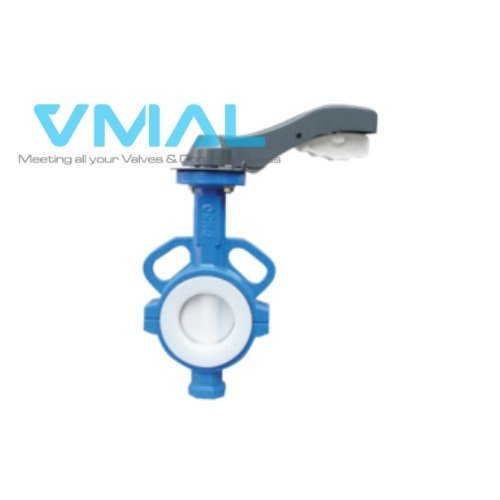
The CI Butterfly Valve with PTFE Seat is a wafer-type butterfly valve designed for reliable flow isolation and control in industrial piping systems. It combines a Cast Iron (CI) valve body with a PTFE seat, providing a practical solution for applications where dependable shut-off, compact installation, and chemical resistance are important.
The wafer butterfly valve design allows the valve to be installed between pipeline flanges without requiring a large valve body or extensive installation space. Its quarter-turn operating principle also enables fast opening and closing, making it suitable for a wide range of industrial fluid-handling systems.
According to the manufacturer’s catalog, the valve is available for applications including HVAC, water supply and sewage, food and beverage, chemical and petrochemical processing, power and utilities, pulp and paper, and shipbuilding. The catalog specifies a PN16 (200 PSI) working pressure and multiple flange and face-to-face standards for integration into different piping systems.
Key Features of CI Butterfly Valve with PTFE Seat
- Cast Iron (CI) body for robust industrial piping applications.
- PTFE seat for applications requiring a PTFE-lined sealing surface.
- Wafer-type construction for compact installation between pipe flanges.
- PN16 / 200 PSI working pressure according to the catalog.
- Face-to-face dimensions available according to API 609, BS 5155, DIN 3202, and ISO 5752.
- Compatible flange standards include DIN, BS, UNI, ISO, ANSI, AS, and JIS.
- ISO 5211 mounting flange for actuator installation.
- Suitable for HVAC, water, sewage, process industries, utilities, and other industrial applications.
What Is a CI Butterfly Valve with PTFE Seat?
A CI butterfly valve uses Cast Iron as the main body material, while the PTFE seat provides the sealing interface around the valve disc. The disc rotates around the valve shaft to open, throttle, or shut off the flow through the pipeline.
When the valve is opened, the disc rotates into the flow path so that fluid can pass through the valve. When the valve is closed, the disc rotates across the pipeline and presses against the seat to isolate the downstream section.
The combination of a Cast Iron body and PTFE seat makes this configuration useful when the application requires a rigid valve body together with a PTFE sealing material.
The catalog lists several material combinations for the main valve components, including Cast Iron, Ductile Iron, Carbon Steel, and Stainless Steel for the body; NBR, EPDM, Viton, Neoprene, Hypalon, and PTFE for the seat; and various stainless steel materials for the shaft and disc depending on configuration.
For this product configuration, the key specification is the Cast Iron body + PTFE seat combination.
Wafer Butterfly Valve Design for Compact Installation
The CI Butterfly Valve with PTFE Seat uses a wafer construction. Unlike larger flanged valve designs, a wafer butterfly valve is installed between two pipeline flanges and secured using the appropriate flange bolts.
This construction helps reduce installation space and can make the valve a practical choice for piping systems where available space is limited.
The catalog identifies the valve type as Wafer Butterfly Valve and provides face-to-face dimensions based on several recognized standards, including:
- API 609
- BS 5155
- DIN 3202
- ISO 5752
The availability of these dimensional standards is important when replacing an existing valve or selecting a valve for a new piping installation because face-to-face dimensions can affect whether the valve can be installed without modifying the surrounding pipework.
PTFE Seat for Industrial Fluid Applications
The seat is one of the most important components of a butterfly valve because it directly contributes to the valve’s shut-off performance.
PTFE (Polytetrafluoroethylene) is used as the seat material in this configuration. The catalog specifically lists PTFE among the available seat materials alongside NBR, EPDM, Viton, Neoprene, and Hypalon.
A PTFE seat can be considered when the application requires a sealing material with the characteristics associated with PTFE. However, the suitability of the valve should always be checked against the actual fluid, operating temperature, pressure, concentration, and process conditions before selection.
For chemical or process applications, users should not select the valve based only on the valve body material. The seat compatibility with the process medium should also be checked carefully.
Working Pressure: PN16 / 200 PSI
The catalog specifies a working pressure of PN16 (200 PSI) for the wafer butterfly valve.
When selecting the CI butterfly valve, the rated working pressure should be compared with the actual pressure of the piping system. The valve should not be selected solely from the nominal pipe diameter.
A proper valve selection should consider at least:
- Pipeline size
- Operating pressure
- Process medium
- Operating temperature
- Required seat material
- Flange standard
- Valve body material
- Manual or automated operation
- Installation conditions
For systems operating close to the valve’s pressure limit, the actual process conditions and applicable standards should be reviewed before ordering.
Available Sizes
The catalog provides dimensional information for a broad range of nominal valve sizes. The listed sizes extend from approximately DN50 through DN1200, with corresponding dimensions provided in the dimensional tables.
This wide size range allows the wafer butterfly valve design to be considered for both relatively compact piping systems and large-diameter industrial pipelines.
For purchasing, the exact valve size should be specified according to the nominal diameter of the pipeline and the required connection standard.
For example:
- DN50 butterfly valve
- DN65 butterfly valve
- DN80 butterfly valve
- DN100 butterfly valve
- DN125 butterfly valve
- DN150 butterfly valve
- DN200 butterfly valve
- DN250 butterfly valve
- DN300 butterfly valve
- Larger sizes up to DN1200
The exact dimensions, bolt-hole configuration, and flange compatibility should be checked against the selected size and applicable piping standard.
Flange and Mounting Standards
One important advantage of this valve design is its compatibility with several commonly used piping standards.
The catalog lists flange standards including:
DIN, BS, UNI, ISO, ANSI, AS, and JIS.
The valve also uses an ISO 5211 mounting flange, which provides a standardized interface for actuator mounting.
This makes the valve suitable for projects where manual operation may later be replaced by automated operation using an electric or pneumatic actuator, provided the actuator and valve torque requirements are correctly matched.
Before ordering, the customer should confirm the required flange standard and actuator mounting arrangement.
Applications of CI Butterfly Valve with PTFE Seat
The manufacturer’s catalog identifies several application areas for this butterfly valve design. These include:
HVAC Systems
Butterfly valves are commonly used for isolation and flow control within HVAC piping systems. The compact wafer design can be useful where equipment rooms and mechanical spaces require efficient use of installation space.
Water Supply and Sewage
The valve can be used in water supply and sewage applications where the selected body and seat materials are suitable for the actual service conditions.
Food and Beverage
The catalog lists food and beverage among the intended application areas. For hygienic or regulated services, the complete valve configuration and material requirements should be checked against the specific process and applicable standards.
Chemical and Petrochemical Processing
The PTFE seat configuration can be considered for selected chemical and process applications. However, chemical compatibility should always be verified for the actual medium, concentration, temperature, and pressure.
Power and Utilities
The valve is also listed for power and utility applications, where butterfly valves can be used for isolation and flow management in various piping systems.
Pulp and Paper
The catalog includes pulp and paper among the application fields for this valve.
Shipbuilding
The valve is also listed for shipbuilding applications, subject to the applicable project specifications and material requirements.
CI Butterfly Valve Material Configuration
The main valve components are manufactured using different material options depending on the selected configuration.
The catalog identifies the following material choices:
| Component | Available Materials |
|---|---|
| Body | Cast Iron, Ductile Iron, Carbon Steel, Stainless Steel |
| Seat | NBR, EPDM, Viton, Neoprene, Hypalon, PTFE |
| Shaft | Stainless Steel 416, 316, 304 |
| Disc | Ductile Iron + Ni, CF8, CF8M, Bronze |
| Pin | Stainless Steel |
| Bushing | PTFE, Bronze |
| O-Ring | NBR, EPDM |
For the CI Butterfly Valve with PTFE Seat, the requested configuration is based on a Cast Iron body and PTFE seat. The remaining component materials should be confirmed according to the specific valve configuration and size.
How to Select the Right CI Butterfly Valve
Choosing the correct butterfly valve requires more than matching the pipe diameter. The following parameters should be checked before purchasing:
1. Nominal size
Select the valve according to the pipeline DN size. The catalog provides dimensional data across a broad range of sizes.
2. Pressure rating
The catalog specifies PN16 / 200 PSI working pressure. Confirm that this rating is suitable for the actual system pressure.
3. Seat material
PTFE should be selected when its material properties and chemical compatibility are appropriate for the process medium.
4. Body material
This product uses a Cast Iron body. Confirm that Cast Iron is suitable for the process environment and mechanical requirements.
5. Flange standard
Check whether the pipeline uses DIN, BS, UNI, ISO, ANSI, AS, or JIS flange dimensions.
6. Actuation
For manual or automated operation, check the required operating torque and mounting interface. The catalog specifies an ISO 5211 mounting flange.
CI Butterfly Valve with PTFE Seat for Industrial Piping
The CI Butterfly Valve with PTFE Seat provides a compact wafer-type valve configuration for industrial piping applications requiring reliable isolation and flow control.
With a Cast Iron body, PTFE seat, PN16 / 200 PSI working pressure, multiple face-to-face standards, and ISO 5211 actuator mounting, the valve can be integrated into a wide range of piping systems.
Its application range covers HVAC, water supply and sewage, food and beverage, chemical and petrochemical processing, power and utilities, pulp and paper, and shipbuilding, as specified by the manufacturer.
If you need a CI butterfly valve with PTFE seat, provide the required DN size, flange standard, operating pressure, process medium, and operating conditions so the correct configuration can be checked before quotation.
Product Specifications
| Specification | CI Butterfly Valve with PTFE Seat |
|---|---|
| Product type | Wafer Butterfly Valve |
| Body material | Cast Iron (CI) |
| Seat material | PTFE |
| Working pressure | PN16 / 200 PSI |
| Face-to-face standards | API 609, BS 5155, DIN 3202, ISO 5752 |
| Flange standards | DIN, BS, UNI, ISO, ANSI, AS, JIS |
| Mounting flange | ISO 5211 |
| Available sizes | DN50–DN1200 listed in catalog |
| Applications | HVAC, water supply & sewage, food & beverage, chemical/petrochemical processing, power & utilities, pulp & paper, shipbuilding |
Request a Quote for CI Butterfly Valve with PTFE Seat
Looking for a Cast Iron butterfly valve with PTFE seat for your industrial piping system?
Contact our engineering team for product selection and quotation. Send us your DN size, flange standard, operating pressure, medium, and required quantity. We can help check the suitable valve configuration for your application before you place an order.
Request a quotation today for the CI Butterfly Valve with PTFE Seat.