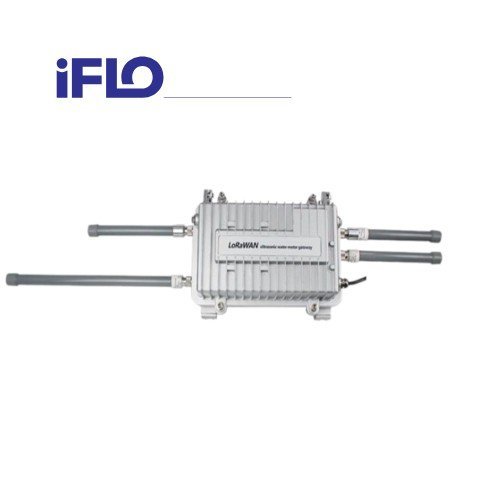
The IFLO LoRaWAN Gateway is a communication gateway used as part of a wireless water metering system. It provides the communication link between multiple smart water meters equipped with LoRaWAN communication and the system server, allowing meter data to be collected and transferred for remote management.
According to the IFLO catalog, the gateway is shown as the central communication device between multiple water meters and a system server. The system diagram also shows connections from the gateway to a server through 2G/3G/4G or Ethernet, while management terminals and online query/payment functions can access the system server.
The catalog presents the gateway as part of a complete LoRaWAN AMR (Automatic Meter Reading) solution rather than as an isolated communication device. The solution is intended to reduce manual meter reading, support remote data transmission, and provide a communication path for water consumption management.
IFLO LoRaWAN Gateway for Smart Water Metering
The IFLO LoRaWAN Gateway works as the communication center of a wireless water metering network. Multiple water meters can communicate wirelessly with the gateway, while the gateway transfers collected information to the system server.
The catalog’s working principle diagram shows several smart water meters communicating with a central Gateway. The gateway then communicates with the System Server, while the server connects with management terminals and online query/payment functions. The connection between the gateway and server is shown through 2G/3G/4G or Ethernet.
This architecture means that the gateway provides an important bridge between the local wireless meter network and the wider data management system.
The catalog describes the overall solution as supporting remote data transmission, recording data, remotely switching valves, and reducing the need for manual services such as door-to-door meter reading.
For ValveLink customers, the IFLO LoRaWAN Gateway can therefore be considered when a water metering project requires wireless communication between multiple meters and a central management system.
LoRaWAN Gateway Working Principle
The basic operating principle is straightforward: smart water meters transmit their measurement information wirelessly to the gateway, and the gateway forwards the collected information to the system server.
The catalog specifically illustrates several water meters communicating with the gateway through wireless links. From the gateway, data is transferred to the system server through 2G/3G/4G or Ethernet.
The server can then be accessed by management terminals, while the diagram also identifies Online Query/Payment as part of the overall system architecture. This shows that the gateway is intended to support a broader water management system rather than simply acting as a local wireless receiver.
The catalog also states that the solution supports Wireless LoRaWAN Protocol and LoRaWAN Class A Protocol. It further describes compatibility with LoRaWAN standards and devices from other companies.
The communication architecture can therefore be summarized as:
Smart Water Meters → LoRaWAN Wireless Communication → Gateway → 2G/3G/4G or Ethernet → System Server → Management Terminal / Online Query & Payment
This structure allows the water meter network to be separated from the wider data network while maintaining a communication path between field meters and the central server.
LoRaWAN Communication and Network Features
The IFLO catalog identifies LoRaWAN as the wireless communication technology used by the smart water metering solution. The catalog states that the solution supports LoRaWAN Class A Protocol and Wireless LoRaWAN communication.
One of the key advantages stated in the catalog is long-distance communication. It specifies a line-of-sight communication distance of up to 7 km in rural environments and 5 km in urban areas. These values are presented by the catalog as communication-distance characteristics of the solution.
The catalog also specifies an operating frequency range of 433 to 923 MHz, with a dedicated metering frequency band and no license requirement stated in the catalog.
Another characteristic highlighted is receiver sensitivity of up to -140 dBm, together with a low-power architecture for the battery-powered meter side of the system.
The catalog states that the solution is fully compatible with LoRaWAN standards and devices from other companies. This is useful when considering integration into a broader LoRaWAN environment, although the exact compatibility and integration requirements should be checked for each project.
Gateway and Smart Water Meter System Architecture
The IFLO LoRaWAN Gateway is designed to work with smart water meters that contain the required wireless communication function. The catalog describes several meter communication options, including single/dual reed switch, single/dual Hall, and inductive pulse configurations.
The catalog also describes the complete solution as supporting non-magnetic inductive metering + LoRaWAN AMR. This allows the water metering system to combine water-volume measurement with automatic wireless data transmission.
The gateway sits between these field meters and the central server. This architecture is particularly useful when many meters are distributed across different locations and manual collection of meter readings would require significant labor.
The catalog highlights several functions associated with the overall solution:
- Remote data transmission
- Data recording
- Remote valve switching
- Reduced manual meter-reading services
- LoRaWAN AMR
- Wireless LoRaWAN communication
- Integration with system server
- Online query and payment functions
- Management through a terminal
These functions are shown as components of the overall smart water metering solution in the catalog, rather than being presented as standalone gateway specifications.
LoRaWAN Gateway Applications
The IFLO LoRaWAN Gateway is intended for smart water metering applications where water consumption data needs to be collected remotely. The catalog states that the water meter solution is ideally suited for residential use and typically used by public utilities.
A typical application can include multiple residential water meters distributed throughout a building, housing area, or utility network. Each meter communicates wirelessly with the gateway, while the gateway forwards the collected information to the central server.
This approach can reduce the need for manual meter reading. Instead of requiring personnel to visit each meter location, the system can transmit meter data through the wireless network.
The catalog also describes the ability to remotely switch valves, providing an additional control function within the water metering architecture.
Potential application environments include:
- Residential water metering
- Public utility water management
- Automated meter reading systems
- Distributed water meter networks
- Remote water consumption monitoring
- Smart water management systems
- Water billing and online query systems
The appropriate network architecture depends on the number and location of meters, the required communication distance, and the connection available between the gateway and the central server.
Technical Characteristics of the IFLO LoRaWAN Solution
The catalog focuses primarily on the complete LoRaWAN water metering solution, and it does not provide a separate technical specification table exclusively for the gateway itself. Therefore, gateway-specific parameters such as standalone enclosure dimensions, gateway power supply, number of supported nodes, antenna specification, or gateway IP rating should not be assumed unless separately confirmed.
The characteristics explicitly provided by the catalog include:
| Parameter | Catalog Information |
|---|---|
| Communication technology | LoRaWAN |
| LoRaWAN protocol | Class A |
| Wireless communication | Supported |
| Operating frequency | 433–923 MHz |
| Receiver sensitivity | Up to -140 dBm |
| Communication distance | Up to 7 km rural / 5 km urban, line of sight |
| Gateway-to-server connection | 2G / 3G / 4G / Ethernet |
| System architecture | Water meters → Gateway → System Server |
| Remote data transmission | Supported |
| Remote valve switching | Supported within the system |
| AMR | LoRaWAN AMR |
| Compatibility | LoRaWAN standards and devices from other companies |
These values are taken from the catalog’s description of the LoRaWAN water metering solution.
The catalog also states that the water meter uses a battery supply of 3.6 V lithium battery, with a specified battery life of 6–10 years under the stated configuration. This specification relates to the smart water meter rather than the gateway itself and should not be treated as the gateway’s power specification.
Selecting an IFLO LoRaWAN Gateway from ValveLink
When selecting an IFLO LoRaWAN Gateway from ValveLink, the gateway should be considered as part of the complete smart water metering architecture rather than as an independent communication product.
The most important points to confirm include the number and type of water meters, required communication coverage, available backhaul connection, server requirements, and required remote management functions.
The catalog supports a system architecture in which multiple LoRaWAN water meters communicate with a gateway, while the gateway communicates with the central server through 2G/3G/4G or Ethernet.
Before ordering, customers should provide:
- Number of water meters
- Water meter communication type
- Approximate installation area
- Required communication distance
- Rural or urban installation environment
- Available 2G/3G/4G or Ethernet connection
- System server requirements
- Requirement for remote valve control
- Requirement for automatic meter reading
- Online query or payment system requirements
The catalog’s communication distance is specified as up to 7 km in rural areas and 5 km in urban areas under line-of-sight conditions. Actual coverage should be evaluated according to the installation environment, building structures, obstacles, antenna placement, and other site conditions.
Contact ValveLink for the IFLO LoRaWAN Gateway and provide your water meter quantity, installation area, required communication distance, available backhaul connection, and smart metering requirements. ValveLink can help check the appropriate gateway configuration and overall LoRaWAN water metering architecture against the catalog.