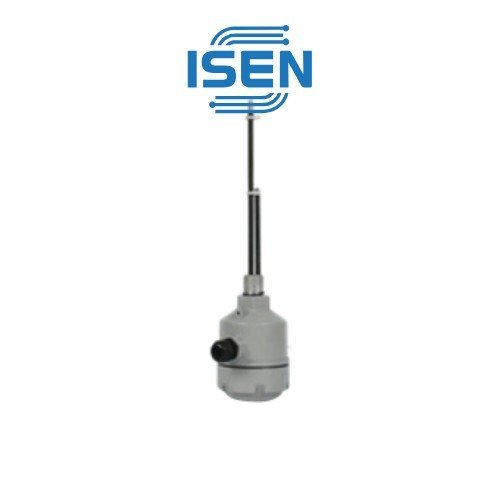
ISEN Electrode Level Switch is a capacitive level measurement solution designed to monitor the level of liquids, oils, and solid micro-particles in industrial containers. Based on capacitive sensing technology, the device detects changes in capacitance between the sensing electrode and the metal vessel as the level of the measured medium changes.
The design uses no moving mechanical parts in the sensing mechanism, which helps improve reliability and reduce maintenance requirements. The sensor is also designed to remain minimally affected by water vapor, dust, condensation, and minor material buildup, making it suitable for demanding industrial level monitoring applications.
Depending on the application, the sensing element can be configured with different probe constructions, materials, connection methods, measurement ranges, output signals, and temperature or pressure ratings. This allows the same product family to be adapted to liquid, powder, corrosive, high-temperature, and other process applications.
Capacitive Electrode Level Measurement Principle
The ISEN level switch uses a capacitive measurement principle. The sensing probe and the conductive metal container form a capacitive sensor. When the level of the medium changes, the amount of the probe surrounded by the measured material also changes, causing the capacitance of the sensor to change.
The sensor electronics measure this capacitance variation and convert it into a level-related signal. Because the dielectric properties of the liquid or material differ from those of the gas phase above it, the capacitance changes progressively as the material level rises or falls.
One important advantage of this design is that the measurement is based on the electrical characteristics around the sensing electrode rather than mechanical movement. This makes the device suitable for applications where conventional mechanical level mechanisms may require frequent maintenance.
During operation, a small amount of material buildup can sometimes occur on the sensing probe. The ISEN capacitive level measurement technology uses radio-frequency admittance technology to reduce the influence of minor buildup on the measurement result. According to the catalog, this helps maintain measurement accuracy even when a small amount of material is present on the probe.
Designed for Liquids, Oils and Solid Materials
The ISEN Electrode Level Switch can be applied to a broad range of media. The catalog specifies applications for liquids, oils, and solid micro-particles, with different probe configurations available depending on the characteristics of the measured material.
For conductive liquids, the catalog recommends PTFE- or PFA-covered probe constructions where appropriate. These configurations can be particularly useful when measuring water-based media, industrial wastewater, and corrosive liquids.
Different electrode designs are available for specific process conditions. Single-probe configurations can be used for many liquid measurement applications, while dual-electrode and flexible-probe designs can be selected for particular tank geometries or longer measuring lengths.
For solid materials, flexible dual-probe configurations are recommended for applications such as coal powder and cement, while other probe constructions can be selected for powders and non-corrosive materials depending on the process conditions.
The catalog also identifies special probe options for aggressive media. Flange-type dual probes with Teflon contact surfaces are recommended for strong acid and alkali detection, helping provide a suitable solution where corrosion resistance is an important requirement.
Probe Configurations and Material Options
A major advantage of the ISEN product family is the range of available electrode configurations. The catalog lists several probe designs, including single probes, flexible single probes, steel shaft probes, flange-type dual probes, and flexible dual probes.
A single probe is intended for metal containers and can detect many types of liquids. The catalog specifies a Teflon-coated version for conductive liquids and corrosion-resistant applications.
Flexible single probes are available for longer installation lengths. For applications where the probe length exceeds approximately 4 meters, the flexible configuration can be considered. When agitation is present inside the vessel, the catalog recommends securing the bottom of the probe.
Steel shaft probes are intended for low-viscosity liquids such as gasoline and are also recommended for mixing applications.
For strong acids and alkalis, flange-type dual probes with Teflon contact surfaces are available. Other dual-probe configurations can be used for liquids and powders that are not corrosive to 316 stainless steel.
Probe materials listed in the catalog include SUS304 stainless steel, SUS316L stainless steel, PP-coated steel, and PTFE-coated steel. PTFE-insulated constructions are particularly useful where corrosion resistance or compatibility with conductive media is required.
The probe design should therefore be selected according to the medium, tank construction, required insertion length, temperature, pressure, corrosion conditions, and whether agitation or material flow is present.
Technical Specifications and Output Options
The ISEN Electrode Level Switch family offers multiple configurations to accommodate different measurement requirements.
For the compact digital capacitive level gauge configuration, the catalog specifies a measurement range of 1–1500 mm and typical accuracy of 0.5% FS. The pressure range is listed as -0.1 to 30 MPa, with a medium temperature range of -50 to 150°C and an ambient temperature range of -40 to 80°C.
The compact digital configuration uses a 24VDC-class supply, with the catalog specifying 18–30VDC for that configuration. It provides 4–20 mA output together with NPN/PNP switching outputs. Protection functions include reverse polarity protection, overload protection, and short-circuit protection, while the housing protection rating is IP67.
Other configurations provide additional communication and output options. The catalog lists:
- 4–20 mA output
- 4–20 mA + HART
- 4–20 mA + RS485 communication
- RS485 communication
Depending on the selected configuration, wiring can be either a two-wire system or a three-wire system with PNP/NPN output.
For the broader capacitive level gauge configuration, the catalog lists a measurement range of 1–9999 mm, capacitance measurement range of 0.1 pF to 2800 pF, accuracy of 0.2% FS, pressure range up to 30 MPa, and temperature capability up to 400°C for the specified configuration.
The exact specifications depend on the selected probe, electrical configuration, process connection, and operating conditions.
Process Connections, Installation and Protection
The ISEN level measurement system can be configured with several process connection options. The catalog includes threaded connections such as G1, G3/4, G1-1/2 and 1-inch PT, as well as flange and chuck connection options. Flange sizes listed include DN25, DN32, DN40, DN50, DN65, and DN80, with custom specifications also available.
Probe measuring lengths include standard options such as 500 mm, 1000 mm, and 1500 mm, while customized lengths can also be specified according to the application.
Correct installation is important for reliable capacitive measurement. The catalog recommends avoiding installation close to feed inlets or material flow paths because direct discharge impact can affect the sensing rod. Where this cannot be avoided, a coaxial probe configuration is recommended.
The electrode or cable should also be kept parallel to the tank wall and away from walls or grounding rods to reduce errors caused by material buildup. The instrument housing should make proper contact with the tank wall, and the tank should not be grounded directly to the signal indicator.
Electrical installation should use dedicated cable routes away from high-power equipment such as pumps, conveyors, and solenoid devices. The catalog recommends metal-shielded cables with the shield grounded at the power panel only. In environments containing heaters or electrical equipment, connecting the equipment casing to the tank can help reduce electromagnetic interference.
These installation requirements are particularly important because capacitive measurement is sensitive to the electrical environment around the probe.
Applications for Industrial Level Monitoring
ISEN Electrode Level Switches and capacitive level gauges can be used across a variety of industrial processes where reliable level information is required.
In industrial production, the technology can be used for liquid storage and processing equipment, including storage tanks, reactors, and process vessels. The catalog specifically identifies applications in chemical plants, oil refineries, and food processing facilities.
In water treatment, capacitive level sensors can monitor water tanks, reservoirs, and wells. They can help operators monitor changes in water level and maintain stable operation of water supply and treatment systems.
The technology is also applicable to the petroleum and natural gas industry, where level monitoring may be required for oil tanks, storage tanks, and pipelines during the storage and transportation of petroleum products and natural gas.
For medical equipment, the catalog identifies applications including medical gas storage tanks and infusion equipment for monitoring liquid or gas levels.
For more demanding process environments, the available probe configurations provide additional flexibility. PTFE-coated and Teflon-insulated probes can be selected for corrosive liquids, while flexible probe designs can be used for long measuring distances and certain powder applications.
For reliable operation, the probe and process connection should always be selected based on the actual medium, vessel material, temperature, pressure, required measuring length, and installation environment.
Valvelink can help you select the appropriate ISEN Electrode Level Switch configuration based on your tank and process requirements. Contact Valvelink to discuss the measured medium, tank dimensions, operating temperature, pressure, required output signal, and installation connection before selecting the suitable configuration.