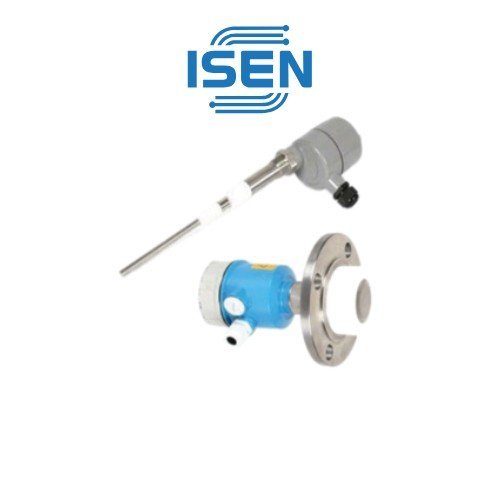
ISEN – Admittance Level Switch
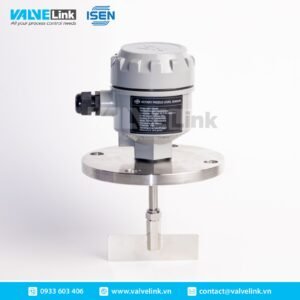
ISEN Admittance Level Switch is an industrial point-level detection device designed to detect the presence or absence of liquids and bulk solids at a predefined level. It uses RF admittance technology to detect changes in the electrical characteristics around the sensing probe when the measured material reaches or leaves the detection point.
Unlike a continuous level transmitter, this device is designed primarily for high-level and low-level detection. The switching signal can be connected to alarms, pumps, conveyors, valves, filling systems, or other industrial control equipment.
The ISEN Admittance Level Switch features a digital electronic design, adjustable sensitivity, configurable switching delay, and probe options for different process conditions. Its construction is suitable for applications involving dust, material buildup, viscous media, temperature variation, and demanding industrial environments.
RF Admittance Technology for Point-Level Detection
The ISEN Admittance Level Switch operates by applying a high-frequency RF signal between the sensing electrode and the surrounding reference structure. When the measured material approaches or contacts the sensing probe, the electrical characteristics around the probe change.
The electronics monitor the change in capacitance and impedance and compare it with a predefined reference. Once the change reaches the configured detection threshold, the output relay changes state.
This principle allows the same technology to detect different types of materials, including liquids, powders, and bulk solids. Since the sensing mechanism does not depend on a mechanical float or moving component, there is less mechanical wear compared with conventional mechanical point-level switches.
Another important feature is the probe’s ability to compensate for the effect of material buildup. In applications involving cement, flour, ash, powder, or other sticky materials, some product may remain attached to the probe after the material level falls. The RF admittance circuit is designed to distinguish this buildup from an actual level change, helping reduce unwanted switching.
This makes admittance level detection particularly useful when the process material is dusty, viscous, conductive, or prone to sticking to the sensing element.
High-Level and Low-Level Alarm Control
The ISEN Admittance Level Switch is intended for point-level control, meaning it detects whether material has reached a specific position rather than continuously measuring the entire tank level.
For a high-level application, the probe can be installed near the top of a tank or silo. When the material reaches the probe, the relay output changes state. The signal can then be used to stop a filling system or activate a high-level alarm.
For a low-level application, the probe can be installed closer to the bottom of the vessel. When the material falls below the detection point, the output can be used to start a filling process, stop equipment, or activate a low-level warning.
The switching function can therefore be integrated into automatic process control systems without requiring a separate signal-processing device.
Typical applications include:
- High-level alarm in storage tanks
- Low-level protection for liquid tanks
- Overfill protection for silos and hoppers
- Material presence detection
- Pump protection
- Automatic filling and discharge control
- Powder and bulk-solid level monitoring
- Alarm systems for process vessels
The device is particularly useful when the required information is simply “material present” or “material absent” at a defined level.
Digital Design and Protection Against Material Buildup
The ISEN Admittance Level Switch uses a digital electronic circuit and a sealed integrated structure. The sensing system contains no mechanical moving parts, which helps reduce mechanical wear and simplifies long-term operation.
The digital design also helps minimize the influence of changes in ambient temperature and humidity. This is important for industrial installations where the surrounding environment may change significantly between operating conditions.
A key function is material buildup compensation. In many level applications, powder or liquid can adhere to the sensing probe. If a conventional capacitive sensor is used without suitable compensation, this buildup can sometimes be interpreted as the presence of material and result in false alarms.
The RF admittance technology is designed to compensate for this effect and distinguish between probe coating and a genuine level condition.
The switch also supports adjustable sensitivity, allowing the detection threshold to be adapted to different materials and installation conditions. A configurable time delay can also be used to prevent rapid switching caused by temporary material movement.
The combination of digital processing, buildup compensation, sensitivity adjustment, and switching delay makes the device suitable for processes where the material surface is not always stable.
Probe Types, Materials and Process Connections
Different industrial processes require different probe constructions. The ISEN Admittance Level Switch can be configured with several probe structures to accommodate different installation positions and process conditions.
Available configurations include standard, flat-plate, high-temperature, split, cable, and corrosion-resistant types. This allows the sensing element to be selected according to the vessel geometry, material properties, and operating environment.
The sensing components can be supplied using materials such as 304 stainless steel, 316L stainless steel, and PTFE. PTFE-insulated configurations are suitable for applications where increased chemical resistance is required.
Process connection options include threaded and flange configurations, with available connections such as:
- 1″ NPT
- 3/4″ NPT
- DN50 flange
- DN80 flange
- Clamp connection
- Customized process connections
Temperature capability depends on the selected probe construction. Standard configurations are suitable for moderate process temperatures, while high-temperature versions are available for more demanding applications.
The appropriate probe material should always be selected according to the measured medium. For corrosive liquids or aggressive chemicals, material compatibility should be checked before selecting the probe.
For bulk solids, the probe structure should also be selected according to particle characteristics, density, moisture, tendency to stick, and the expected material movement around the detection point.
Technical Specifications and Relay Output
The ISEN Admittance Level Switch is designed as a discrete switching device rather than a continuous analog level transmitter. Its output can therefore be connected directly to an industrial control circuit, alarm system, or intermediate relay when the electrical requirements are compatible.
Available power supply configurations include 220 VAC ±10%, 50/60 Hz and 24 VDC ±10%, depending on the selected version.
The relay contact capacity is specified at up to 250 VAC, 5 A. The switching arrangement can be provided as SPDT, while DPDT configurations are also available for applications requiring additional contact functionality.
The device provides adjustable sensitivity with multiple levels, allowing the detection response to be adapted to different materials. A configurable switching delay of up to approximately 59 seconds can also be used to prevent unnecessary switching caused by short-term fluctuations.
The alarm logic can be configured for upper-limit or lower-limit detection, depending on the required application.
The control unit is designed for an ambient operating temperature of approximately -40 to 65°C, while the permissible process temperature depends on the selected probe construction.
The enclosure is specified with IP65 protection, helping protect the electronics from dust and water exposure under the specified conditions. Explosion-proof configurations are also available for suitable hazardous-area applications.
Installation and Application Considerations
Proper installation is essential for reliable RF admittance level detection. The probe should be positioned so that it can accurately detect the material while avoiding unnecessary interference from the tank wall, inlet flow, agitators, or other conductive components.
For installation inside a vessel, the insulated end of the sensing element should extend sufficiently into the tank. For side-mounted installations, the insertion length and probe structure should be selected according to the tank wall thickness and required detection position.
When installed vertically, sufficient clearance should be maintained between the sensing probe and the tank wall. This helps ensure that the electrical field around the electrode is not excessively influenced by nearby conductive structures.
The probe should also be kept away from direct material impact where possible. If material continuously falls directly onto the sensing element, mechanical protection or an alternative installation position may be required.
For applications involving significant material movement or agitation, suitable measures should be taken to reduce unnecessary fluctuation around the probe.
Outdoor installations should be protected from direct exposure to rain where necessary. The electrical housing should be properly sealed, cable entries should be tightened, and grounding should be completed according to the installation requirements.
The power supply and relay wiring must match the selected configuration. The sensing probe should also be installed with sufficient clearance to allow the RF field to operate correctly.
Industrial Applications of ISEN Admittance Level Switch
ISEN Admittance Level Switches are suitable for a wide range of industrial point-level detection applications involving both liquids and bulk solids.
In cement plants, the switch can be used for high- and low-level detection in cement silos, powder hoppers, and material storage systems. Its resistance to material buildup makes RF admittance technology useful for dusty applications.
In power generation, it can be applied to coal handling, ash systems, and other material storage or transfer processes where reliable point-level detection is required.
In food processing, the switch can monitor powders and ingredients such as flour and other bulk materials in storage and mixing systems.
In pharmaceutical manufacturing, it can be used for raw-material storage and process vessels where reliable material presence detection is required.
Other applications include paper manufacturing, metallurgy, chemical processing, water treatment, and general industrial storage systems.
For liquid applications, the switch can provide high- or low-level protection in tanks containing water, chemicals, and other process liquids. For bulk solids, it can detect material levels in silos, hoppers, bins, and conveying systems.
When selecting an ISEN Admittance Level Switch, Valvelink recommends considering the measured material, vessel type, detection point, material buildup characteristics, operating temperature, pressure, probe material, process connection, power supply, relay configuration, and hazardous-area requirements.
With the appropriate configuration, the ISEN Admittance Level Switch provides Valvelink customers with a practical solution for reliable high-level, low-level, overfill, and material-presence detection in demanding industrial processes.