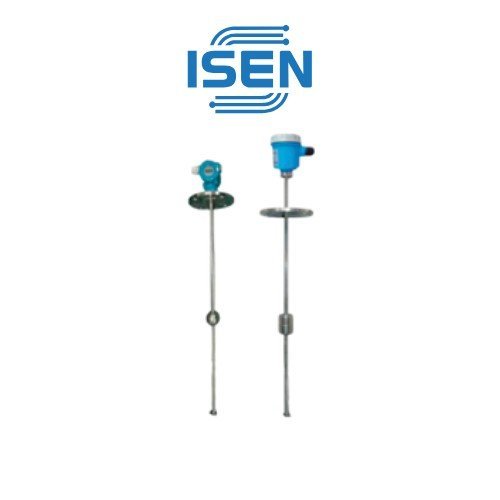
ISEN Magnetic Float Level Transmitter is a continuous liquid level measurement device designed for tanks, vessels, storage systems, and other industrial applications where reliable level monitoring is required. Unlike a simple float level switch that only provides an ON/OFF signal, this type of transmitter provides a continuous 4–20 mA level signal, allowing the actual liquid level to be monitored and controlled.
The measurement principle combines a magnetic float with reed switches and precision resistors installed inside a sealed, non-magnetic guide tube. As the liquid level changes, the float moves along the tube under buoyancy. The magnetic element inside the float changes the electrical resistance of the internal circuit, and the electronics convert this resistance change into a standard output signal.
The product is available with different wetted materials, process connections, measurement ranges, float configurations, display options, and communication outputs. This makes it suitable for applications ranging from oil and chemical storage to water treatment, food processing, power generation, and environmental monitoring.
Magnetic Float Level Measurement Principle
The ISEN Magnetic Float Level Transmitter works by converting the physical movement of a float into a continuous electrical signal.
Inside the sealed non-magnetic conduit, a series of reed switches and precision resistors are arranged along the measurement path. The float contains a hollow body with a ring-shaped magnetic steel element. As the liquid level rises or falls, the float moves up or down along the conduit.
When the magnetic float passes the reed switches, the magnetic field causes the corresponding switch to change state. This changes the resistance value of the electrical circuit. The transmitter electronics detect this resistance variation and process it into a standard 4–20 mA output corresponding to the liquid level.
This principle allows the transmitter to provide continuous level information rather than simply indicating whether the liquid has reached a particular point.
Because the indicating mechanism is completely isolated from the measured medium, the internal electrical components are protected from direct contact with the liquid. The catalog also highlights that the measurement is independent of foam and liquid conductivity and is not affected by liquid specific gravity and pressure under the stated operating conditions.
Continuous Level Monitoring for Industrial Tanks
One of the main advantages of a magnetic float level transmitter is its ability to provide continuous level monitoring. The ISEN product is designed for measurement ranges from 300 mm to 6000 mm, with customized ranges available according to actual application requirements.
This makes the transmitter suitable for different tank sizes and liquid storage arrangements. It can be used where operators need to know the changing liquid level rather than only receiving a high-level or low-level alarm.
The insertion-type design is particularly useful for closed containers, underground tanks, and high-level water tanks. According to the catalog, it is designed to overcome false level indications caused by suspended matter and foam, making it suitable for applications where these conditions may otherwise affect level detection.
The continuous output can be connected to a control unit, digital display, PLC, or other industrial monitoring equipment. With an appropriate control system, the level signal can be used for automatic filling, draining, process control, alarm management, or remote monitoring.
The transmitter can also be supplied with a local display, allowing the liquid level to be observed directly at the installation location while still providing a remote output signal.
Materials, Floats and Process Connection Options
Different process media require different materials, which is why the ISEN Magnetic Float Level Transmitter is available in several construction options.
The catalog lists wetted material choices including SUS304 stainless steel, SUS316L stainless steel, polypropylene (PP), and PVDF. These options allow the transmitter to be selected according to the characteristics of the liquid and the installation environment.
The magnetic float itself is available in multiple sizes and materials. The selection table includes stainless steel, PP, and PVDF float options, with different dimensions and applicable liquid density ranges. Special float specifications can also be customized according to the application.
Process connections include:
- G1-1/2″ threaded connection
- DN50 flange connection
- Clamp connection
- Adjustable threaded connection
- Adjustable flange connection
Thread sizes, insertion depths, and flange dimensions can be customized where required.
This flexibility is useful when replacing an existing level instrument or integrating the transmitter into a tank that already has a defined process connection.
The appropriate float should be selected according to liquid density and temperature as well as the required measurement range. The catalog provides different density and temperature limits for the available float configurations, so the float should not be selected based on physical dimensions alone.
Output Signals, Accuracy and Technical Specifications
The ISEN Magnetic Float Level Transmitter is primarily designed around a 24 VDC power supply and continuous 4–20 mA output. Two-wire configurations are available for standard 4–20 mA transmission, while other configurations add HART or RS485 communication.
The available wiring configurations include:
- 4–20 mA two-wire
- 4–20 mA + HART two-wire
- 4–20 mA + RS485 two-wire
These options allow the same basic level measurement principle to be integrated into different industrial automation architectures. HART can be selected where digital communication is required alongside the analog signal, while RS485 provides a digital communication option.
The catalog specifies an intrinsic error of approximately ±1% FS, with a standard accuracy specification of ±5 mm also listed. The standard operating temperature range is -20 to 80°C, with configurations available for temperatures up to 120°C. The pressure rating is specified at ≤10 MPa.
The product is listed with IP65 ingress protection and is available in standard and explosion-proof versions. The catalog identifies an Ex(ia) II BT4 explosion-proof configuration.
Depending on the selected configuration, the housing can be made from aluminum alloy or PP, and a local display can be included.
Installation and Application Considerations
Correct installation helps ensure stable float movement and reliable level measurement. The transmitter should be installed away from the tank inlet and outlet where possible. Strong liquid movement caused by incoming or outgoing flow can disturb the float and affect measurement stability.
If the tank contains agitation, the catalog recommends using a wave-proof tube or wave-proof baffle to reduce excessive movement around the float.
For longer level gauges, installation support becomes increasingly important. The catalog recommends that for level gauges longer than 3 meters, the conduit should be positioned at the bottom of the tube to improve strength and stability.
The area around the conduit should also be free from magnetic conductors and magnetic impurities. Such materials could interfere with the magnetic float, potentially preventing normal float movement.
Another important point is calibration. The catalog specifically advises users not to adjust the ZERO and SPAN settings unnecessarily, because these values are adjusted at the factory.
The level gauge should also be protected against strong physical impact. When installing the instrument, sufficient clearance should be provided to allow the float to move freely throughout its measurement range.
For installation on concrete tanks or pools, an L-shaped angle-iron bracket can be used to support the instrument where appropriate.
Applications and Selection Guide
ISEN Magnetic Float Level Transmitters are suitable for a broad range of industrial liquid level applications. The catalog identifies applications in petrochemical, chemical, food processing, environmental protection, and electric power industries.
In the petroleum industry, the transmitter can be used for liquid level monitoring and oil level control in storage tanks, pipelines, oil wells, and related equipment.
In the chemical industry, it can provide continuous level monitoring in storage tanks, reactors, separators, and other large process vessels.
For food processing, the transmitter can monitor raw materials, liquid foods, and beverages in processing equipment, storage tanks, and mixers.
In environmental protection and water treatment, applications include large sedimentation tanks, sewage treatment systems, dams, and reservoirs. In the power industry, it can be applied to cooling towers, boilers, generator sets, and equipment used for cooling or supply water level monitoring.
When selecting the transmitter, the main parameters to consider are measurement range, liquid density, process temperature, liquid compatibility, process connection, float material and size, output signal, display requirement, and explosion-proof requirements.
Valvelink can help select the appropriate ISEN Magnetic Float Level Transmitter configuration based on the tank dimensions, liquid properties, installation conditions, and required control system interface.