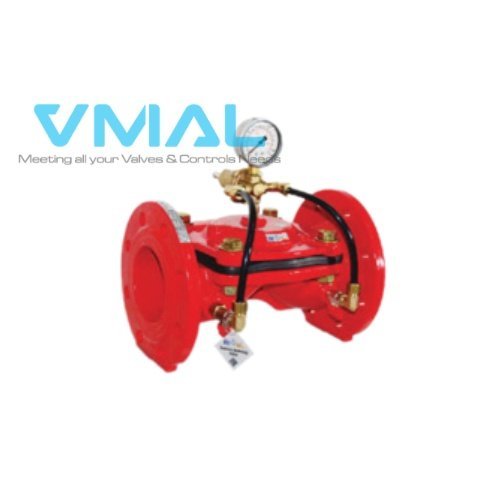
The VMAL Pressure Reducing Valve is a flanged control valve designed to reduce and regulate downstream pressure in piping systems. It is intended for applications where the pressure supplied to downstream equipment needs to be maintained at a controlled level despite changes in upstream pressure or flow conditions.
According to the VMAL catalog, the pressure reducing valve is available with flanged connections, a PN16 (200 PSI) working pressure rating, and flange standards including DIN, BS, UNI, ISO, ANSI, AS, and JIS. The catalog lists applications across HVAC, water supply and sewage, food and beverage, chemical and petrochemical processing, power and utilities, paper and pulp, and shipbuilding.
VMAL Pressure Reducing Valve for Pressure Control
A pressure reducing valve is installed in a pipeline to lower the pressure from the upstream side to a controlled downstream pressure. This helps protect downstream piping, equipment, and process components from pressure levels that are higher than required for normal operation.
The VMAL Pressure Reducing Valve uses a control assembly consisting of a diaphragm, spring, pilot valve, needle valve, pressure gauge, and other internal components. The catalog identifies these components as part of the valve construction, allowing the valve to regulate pressure through its internal control mechanism.
The valve is supplied with a flanged connection, making it suitable for installation in industrial piping systems where a bolted flange connection is required. The catalog supports several international flange standards, including DIN, BS, UNI, ISO, ANSI, AS, and JIS.
For ValveLink Europe customers, the VMAL Pressure Reducing Valve is therefore suited to systems where controlled downstream pressure is required and the piping system uses a compatible flange standard.
Pressure Reducing Valve Construction and Materials
The VMAL Pressure Reducing Valve incorporates multiple components that work together to control the pressure. The catalog identifies the main parts as the body, seat, plate, disc, diaphragm, nut, stem, spring, eye bolt, bonnet, bolts, needle valve, pressure gauge, pilot valve, and ball valve.
The catalog’s material table specifies different materials for the main components, including cast iron (CI), brass, carbon steel, stainless steel, EPDM, and DI, depending on the component.
The construction includes a diaphragm-operated control mechanism. The spring, diaphragm, stem, pilot valve, and needle valve form part of the pressure-control assembly, while the body and seat provide the main flow passage and sealing structure.
This construction allows the valve to regulate pressure through the pilot-controlled mechanism rather than simply acting as a manually adjusted restriction. The pressure gauge shown in the catalog can also be incorporated into the control arrangement for pressure monitoring.
When selecting the valve, the material configuration should be checked against the required application and operating conditions because the catalog specifies different materials for different valve components.
VMAL Pressure Reducing Valve Technical Specifications
The catalog specifies a PN16 (200 PSI) working pressure for the pressure reducing valve. The valve uses a flange connection, with the available flange standards including DIN, BS, UNI, ISO, ANSI, AS, and JIS.
| Parameter | Catalog Specification |
|---|---|
| Valve type | Pressure Reducing Valve |
| Connection | Flange |
| Working pressure | PN16 (200 PSI) |
| Flange standards | DIN, BS, UNI, ISO, ANSI, AS, JIS |
| Dimensions | mm |
| Pressure-control mechanism | Diaphragm / pilot controlled |
| Main control components | Diaphragm, spring, pilot valve, needle valve |
| Pressure monitoring | Pressure gauge shown in construction |
| Applications | HVAC, water supply & sewage, food & beverage, chemical/petrochemical processing, power & utilities, paper & pulp, shipbuilding |
The PN16 designation represents the working pressure classification stated by the catalog. It should not be interpreted as a universal allowable operating condition for every medium and temperature. Actual selection should consider the complete operating conditions and the relevant valve configuration.
The catalog also provides dimensional information for the valve series, with dimensions presented in millimeters.
Pressure Reducing Valve Size and Flange Dimensions
The VMAL Pressure Reducing Valve catalog provides dimensional data covering a broad range of nominal pipe sizes. The dimension table extends from DN50 through DN2000, allowing the valve series to be considered for both smaller industrial pipelines and large-diameter water or utility systems.
The catalog identifies dimensional parameters including L, D, D1, D2, n×d, and other installation dimensions. The available dimensions vary according to nominal diameter and pressure class.
For the PN16 configuration, the catalog provides dimensional values for the valve body and flange arrangement. The dimensional table should be used when checking the valve against an existing pipeline because the face-to-face dimension, flange outside diameter, bolt-hole arrangement, and other dimensions need to correspond with the piping system.
Before ordering, ValveLink Europe recommends confirming:
- Nominal pipe diameter
- Required flange standard
- Working pressure
- Face-to-face installation dimension
- Flange outside diameter
- Number and diameter of flange bolt holes
- Available installation space
This is particularly important for large-diameter installations because the physical dimensions increase substantially with valve size.
Pressure Reducing Valve Applications
The VMAL Pressure Reducing Valve is listed in the catalog for a wide range of industrial and utility applications. These include HVAC, water supply and sewage, food and beverage, chemical and petrochemical processing, power and utilities, paper and pulp, and shipbuilding.
In HVAC systems, pressure reduction can be required to maintain suitable pressure conditions for downstream piping and equipment.
For water supply and sewage systems, a pressure reducing valve can be installed where the downstream network needs to operate at a controlled pressure rather than receiving the full upstream pressure.
The catalog also identifies food and beverage and chemical/petrochemical processing as application areas. For these applications, material compatibility and the actual process conditions should be reviewed carefully before valve selection.
In power and utility systems, as well as paper and pulp and shipbuilding, the valve can be considered for pipeline sections where downstream pressure regulation is required.
Because the catalog covers several industries rather than specifying one particular medium, the correct material configuration and operating conditions should be confirmed for each project.
VMAL Pressure Reducing Valve Selection and Ordering from ValveLink Europe
Selecting the correct VMAL Pressure Reducing Valve requires more than simply choosing the pipe size. The valve should be matched to the required downstream pressure, working pressure, nominal size, flange standard, medium, and installation dimensions.
The catalog specifies a PN16 (200 PSI) working pressure and supports multiple international flange standards, including DIN, BS, UNI, ISO, ANSI, AS, and JIS.
When requesting a quotation from ValveLink Europe, it is useful to provide the following information:
- Nominal pipe size
- Upstream pressure
- Required downstream pressure
- Fluid or process medium
- Operating temperature
- Required flange standard
- Installation or face-to-face requirements
- Required quantity
For larger sizes, the catalog provides dimensions up to DN2000, so the actual pipeline dimensions should be checked carefully before ordering.
ValveLink Europe can help check the required configuration against the VMAL catalog data and confirm the appropriate size, flange arrangement, and technical specifications for the application.
Contact ValveLink Europe to request a quotation for the VMAL Pressure Reducing Valve and provide your pipeline size, upstream/downstream pressure, medium, flange standard, and operating conditions for technical selection.