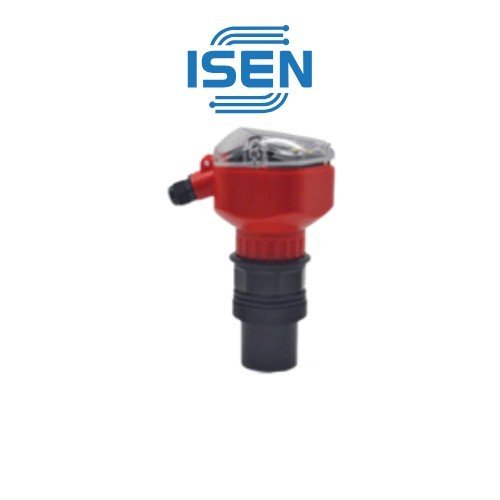
ISEN Ultrasonic Level Transmitter is a non-contact level measurement solution designed for continuous monitoring of liquids and other materials in tanks, vessels, and process systems. Instead of placing the sensing element directly into the measured medium, the transmitter uses ultrasonic waves to determine the distance between the sensor and the material surface.
The product family includes different ultrasonic configurations for applications requiring short or extended measuring ranges, compact installation, wireless communication, local display, or integration with industrial automation systems. Depending on the selected configuration, available outputs include 4–20 mA, RS485/Modbus, HART, switch outputs, and wireless communication such as NB-IoT, LoRa, and 4G.
ISEN ultrasonic level measurement solutions are designed with features such as digital filtering, echo recognition, automatic temperature compensation, anti-condensation functions, and user-defined sound velocity. These functions help the transmitter maintain stable measurement in practical industrial environments.
Non-Contact Ultrasonic Level Measurement Principle
The ISEN Ultrasonic Level Transmitter measures level by sending an ultrasonic signal toward the surface of the measured material and analyzing the returned echo. The distance between the transmitter and the material surface is then used to determine the level.
Because the sensor does not need to physically contact the liquid, there is no probe or float continuously exposed to the process medium. This makes ultrasonic measurement useful for applications where direct contact with the liquid is undesirable or where the tank contains materials that could create maintenance problems for mechanical level instruments.
The transmitter can measure level, liquid level, volume, weight, and other calculated process values, depending on the selected configuration and application. The electronics use digital filtering and echo recognition to identify the useful measurement signal and reduce the influence of unwanted interference.
Temperature can also influence the speed at which ultrasonic waves travel through the air above the liquid. ISEN ultrasonic configurations therefore incorporate an internal temperature sensor or automatic temperature compensation to correct the measurement according to the operating temperature.
For special materials, the transmitter supports user-defined sound velocity. This provides additional flexibility when the acoustic characteristics of the measurement environment differ from standard conditions.
High-Precision Measurement with Short and Extended Ranges
The ISEN ultrasonic level transmitter family includes different sensor designs to cover different measuring distances. Compact high-precision versions are available for applications with relatively short measurement distances, while reinforced and regular ultrasonic configurations can cover significantly longer ranges.
The high-precision small-blind-area configuration is specified with measuring ranges of approximately 1 m, 2 m, and 3 m, with a blind area of less than approximately 0.03–0.15 m, depending on the selected range. The catalog also specifies approximately 1 mm resolution and accuracy options below ±11 mm or ±1.5 mm depending on the range and configuration.
For extended-range applications, other ultrasonic configurations are available with ranges such as 3 m, 5 m, 8 m, 10 m, 12 m, 15 m, and up to approximately 40 m. Their blind area varies according to the measuring range and sensor design.
This range of configurations allows the transmitter to be selected according to the physical dimensions of the tank rather than forcing every application to use the same sensor.
When selecting an ultrasonic transmitter, the measuring range should not be considered alone. The required blind area, installation height, material surface condition, tank geometry, temperature, and possible sources of interference should also be evaluated.
For applications where the sensor must be mounted above the material with no direct contact, maintaining an appropriate distance from the maximum material level is particularly important because the sensor has a minimum measurement distance known as the blind area.
Anti-Condensation, Echo Recognition and Interference Filtering
Industrial tanks can present difficult measurement conditions. Condensation, foam, changing material surfaces, electrical interference, and unwanted echoes can all influence an ultrasonic measurement.
The ISEN product family includes a built-in anti-condensation function, which the catalog identifies as a patented feature. This function is intended to reduce the influence of condensation around the sensing area.
The transmitter also incorporates digital filtering and echo recognition. Instead of simply responding to every reflected ultrasonic signal, the electronics process the received echoes to identify the signal associated with the actual measurement.
Some configurations also provide manually adjustable fixed interference filtering. This allows users to address specific interference conditions that may be present in a particular installation.
The transmitter supports automatic temperature compensation through its built-in temperature sensing function. This is important because the propagation characteristics of ultrasonic signals change with temperature.
For special substances or environments, the user-defined sound velocity function provides another adjustment option. Rather than assuming a fixed acoustic condition, the measurement can be configured according to the actual sound velocity required by the application.
These functions are particularly useful when the transmitter is installed in an industrial environment where measurement conditions are not perfectly stable.
Output, Communication and Power Supply Options
A major advantage of the ISEN Ultrasonic Level Transmitter family is the number of available interfaces. Depending on the selected configuration, the transmitter can provide analog, digital, switching, and wireless outputs.
Available analog outputs include:
- 4–20 mA
- 0–20 mA
- 0–5 V
- 0–10 V
Digital communication options include RS485/Modbus and HART in applicable configurations. Switch outputs are also available on selected versions, including NPN outputs and relay outputs.
Wireless communication options can include NB-IoT, LoRa, 4G, RF, Bluetooth, and Wi-Fi, depending on the transmitter configuration. Some versions are therefore suitable for applications where running a traditional signal cable from the tank to the control system is inconvenient.
The power supply also varies according to the selected design. The catalog lists external supply configurations such as 12–28 VDC and 18–32 VDC, while certain specialized versions incorporate battery power and solar charging.
For example, reinforced ultrasonic configurations can include a built-in battery supply and solar charging, which can be useful for remote measurement locations where conventional electrical power is difficult to provide.
The split ultrasonic level meter configuration can also provide additional data acquisition functions, including MiniSD card storage and USB output, as well as wireless communication and relay outputs.
This makes the ISEN product family adaptable to both conventional wired automation systems and more distributed monitoring architectures.
Installation, Materials and Environmental Conditions
Ultrasonic level measurement is non-contact, but installation position still has a significant influence on measurement quality. The sensor should have a clear acoustic path toward the measured surface and should be positioned appropriately relative to tank walls, internal structures, pipes, agitators, and other objects that could generate unwanted echoes.
The catalog provides different installation connections depending on the selected configuration. These include threaded connections such as M30 × 1.5, G1, G2/2NPT, G3, and M60 × 2, with connection options varying between transmitter versions.
Available housing and sensor materials include PBT, ABS, PP, PVDF, PTFE, 304 stainless steel, and cast aluminum. The appropriate material should be selected according to the installation environment and the requirements of the application.
Environmental specifications also vary between configurations. Typical working temperature ranges include approximately -20 to 65°C, while certain reinforced configurations support higher temperatures, with the catalog specifying versions for applications up to approximately 100–110°C.
Protection is available up to IP65, depending on the selected configuration. Explosion-proof versions are also listed with an Ex ia II BT4 Ga classification.
For outdoor or remote installations, the selection should consider temperature, humidity, condensation, electrical interference, power availability, and the required communication method rather than focusing only on measurement range.
Applications of ISEN Ultrasonic Level Transmitter
ISEN Ultrasonic Level Transmitters can be used in applications where continuous, non-contact measurement of material level is required.
For water and liquid storage tanks, the transmitter can continuously monitor the liquid surface and transmit the measured value to a PLC, display, SCADA system, or other control equipment.
In industrial process tanks, non-contact measurement can be useful when the measured liquid should not come into direct contact with a mechanical sensing element. The transmitter can also provide calculated values such as volume or weight when the appropriate configuration and tank parameters are applied.
For chemical and corrosive applications, the non-contact principle can reduce direct exposure of the sensing element to the measured medium. However, actual chemical compatibility and environmental conditions should still be evaluated when selecting the transmitter and its housing materials.
Remote applications can benefit from the available NB-IoT, LoRa, 4G, RF, Wi-Fi, or Bluetooth communication options. Battery-powered and solar-assisted configurations can also be considered where conventional power is unavailable.
For shorter tanks requiring a compact sensor and small blind area, the high-precision small-blind-area configuration can be considered. For larger tanks and longer measurement distances, reinforced or regular ultrasonic configurations provide extended measuring ranges.
When choosing an ISEN Ultrasonic Level Transmitter, Valvelink recommends considering the tank height, required measuring range, blind area, material being measured, surface condition, operating temperature, installation connection, power supply, output signal, communication requirements, and environmental conditions.
Valvelink can help select the appropriate ISEN configuration for your application and control system, including the required 4–20 mA, HART, RS485/Modbus, relay, or wireless communication interface.